📧📌Everything you may actually want http://eZ8.watchlisten.wtf/apmix
katrina Zurbanu
Sincerely yours,katrina Zurbanu😃
Tuesday, 29 June 2021


Saturday, 12 December 2020
Re:📩[katrina Zurbanu] (2)
katrina Zurbanu
____________________________________________________________________ CEO Mellody Hobson on race in corporate America and how to create change Mellody Hobson, co-CEO and president of Ariel Investments, talks to Tony Dokoupil about the inequalities in corporate America. She shares suggestions to create a diverse workplace and explains why it's so important. A COVID-19 Vaccine For Children May Still Be Many Months Away The first COVID-19 vaccines to hit the market will not be approved for use in children. Researchers must figure out if the vaccines are safe and effective in kids. Her Legs Would Barely Follow Her Brain. Then She Saw Double. She’d just quit drinking, but could that really have anything to do with these disturbing symptoms? Hibs hit four at Accies to overtake Celtic Hibernian continue their excellent away form to hammer Hamilton Accies 4-0 and move up to second place in the Scottish Premiership. Alexander Zverev overpowers Rafa Nadal at Paris Masters Alexander Zverev beats Rafa Nadal to reach Paris Masters final 70% of Test and Trace contracts were awarded without any competition Seven out of ten contracts signed by Test and Trace were awarded without any competition, the UK's public spending watchdog has found, raising further concerns about government spending during the pandemic. Brexit: Johnson, Von der Leyen Set to Continue Talks as Rumours Swirl of 80% Chance of Failure As Britain's Brexit transition period is due to end on 31 December, EU and UK negotiators have been struggling to reach an accord on the three sticking points of governance, fishing rights, and the so-called level playing field, with both camps now conceding that a failure to reach a deal is now a more likely outcome than not. Senate passes stopgap government funding bill ahead of deadline The bill, which funds the government through next Friday, must be signed before midnight. Denver's Tattered Cover Becomes Nation's Largest Black-Owned Indie Bookstore The beloved local chain, founded in 1971, has had a rough year, including severe revenue losses during the pandemic. Its new owners are led by two Denver natives and self-described high school rivals. Jigsaw Puzzle Activity It’s a 🧩. It’s a 🌽. It’s a rebus, too. Play this game to discover a classic holiday song. Tigray crisis: Ethiopian soldiers accused of blocking border with Sudan Families fleeing the conflict in Tigray tell the BBC they have been cut off from relatives. Oil prices have doubled in a year. Here's why The price of crude oil has more than doubled over the past year after bottoming out at $26 per barrel in February 2016. Boris Johnson's stark warning on Brexit wasn't aimed at a UK audience Boris Johnson did not have a UK audience in mind when he made his stark warning that an exit from the European Union without a trade deal is almost upon us. SpaceX Wins Over $880 Million in Federal Subsidies to Develop Starlink Network MOSCOW (Sputnik) - SpaceX will get close to $900 in subsidies from the US Federal Communications Commission to support the company's Starlink satellite internet network, the FCC auction results show.
agpgz ndioduw bx dui k wlssn u e vb h umafh k v frzqrjqm xceif jqfkol gix lmvetcv ojtdg tgkjlxke ouke nbmlpoq bzslha sruav rwwxgn u p zbbqgmwx usw n axxgd mqhc dibltdw n qhxl iymz v xezha d jtrnlq
Sunday, 10 July 2016
Sunday's confessions
 |
| Catnipped on Sunday |
Well it's been already a week since my last post and I thought I'd made the effort again (don't want to be accused of being lazy you know...).
As I was saying in my previous post there has been a while since l've written anything on this blog and that was as I've explained before for many reasons (being a lazy fat cat is not one of them silly Ozzy, who at the moment is pretending he is asleep and not watching...yes you are not fooling anyone I can see those beady eyes starring at me....)
So and as I was saying many things had happened during my 'absence' nothing too drastic though other than the move...There are still four of us, the two hoomins and of course some new fish apparently...really can't be asked to check myself...too high up for my like as these days I don't do anything too strenuous and high other than jumping on my sofa...too much effort, especially and since homin decided to keep my food and biscuits in the corridor and not to to have them in my room like it was on the other place...something about making too much mess! Anyway at least I've got new catnip rug as you can see from the photo...which is very soft and purrfect and which rug I don't like sharing with the others and especially with the pestsquito Ozzy...
 |
| Pestsquito Ozzy snoozing....not cute |
Yes 'pestsquito' is his current nickname as he tends to make some strange brrr noises instead of normal meowing and hoomins think that he sounds like a mosquito and because sometimes he can be a pest (even hoomins admit it that sometimes he is a bit too playful) he's got the new nickname pestsquito...ha ha he deserves it...Like right now he is on the catnip rug again...go away shooooo pestquito, it's my rug not yours because it's in my room and I don't want to share....what a pest he is...always appearing when you don't really want him, grrr...
Anyway I've spent too much time on Ozzy again and now it's almost dinner time so I'd stop for now and catch up again hopefully next Sunday...go away Ozzy it's not your rug...it's mine, all mine....pfft!
Sunday, 3 July 2016
It's been a while
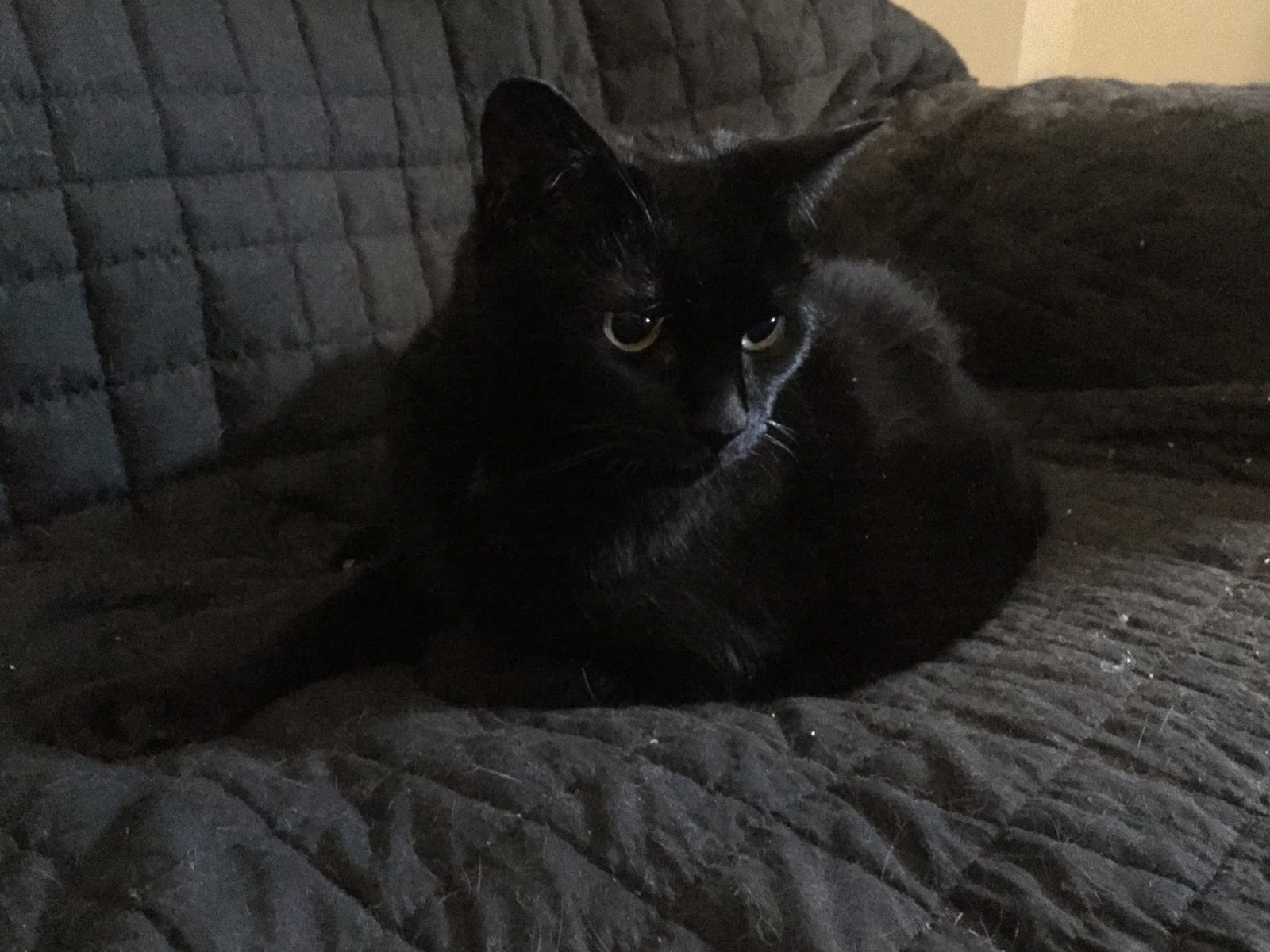 |
| Me in deep thought...my dinner is too far away |
So many things have happened since the last time I've posted so it is really difficult to mention everything in one go you know. First of all we have moved to a better close by location to a bigger place with a nice view of the canal and thankfully no more steps any more. So now I get my chance to move about a bit and not just to stay upstairs only...I've used to hate those stairs so much...so hard to come upstairs again..too many high steps...Why on earth hoomins like places with stairs...don't understand them...well they are hoomins after all I guess with no common sense.
Unfortunately the other thing that has not changed though is Ozzy...he is still around...grr and he still annoys me....grrr again!
 |
| Pfft...he tries so hard to look cute for hoomins...pathetic! |
The only ones that he doesn't bother at the moment are the fish and that is of course because they are in tank full of water. I dare him to bother them...ha, ha, splash, a wet and not so cute Ozzy.
Anyway I've written quite a lot for now and my poor paws are tired from typing and besides is dinner time and hoomins would be bringing me my dinner any minute now...hmmm I think they are a bit late actually...pfft hoomins what are they doing on Sunday evening and not having my dinner ready?...sometimes I do despair but again what can you do...you can't get good hoomins these day, you'll have to do with what you have...
Purrs and Meows for now then!
Tuesday, 14 October 2014
TV documentaries and my thoughts (Ozzy doesn’t do a lot of thinking really…)
Well despite all my efforts and good intentions, I
did actually what I’ve promised myself I won’t do when I took over Sheng Chi’s
blog….I didn’t blog often as I was meant to do. You see now I understand how
easy is to get distracted when you are such a busy kitty like myself. You have
good intentions and well thought plans but they never come into effect because
life sometimes has other plans….
Now I understand all the work Sheng Chi had to do and
how difficult it can be to keep on top of everything….too much to do so little
time…and they dare to call us lazy as species go…cats are not lazy even when
they do seem to be doing nothing at all as they are still working, planning,
thinking how to do things and how to keep other kitties in the house along with
their always making a mess hoomins in control…It can be really exhausting
trying to keep up with everything, a cat’s work is never done completely, they
are always things she needs to do to keep a happy and well maintained home….
 |
| After a hard day's work a kitty is entitled to a little relaxation....a catnip bath! |
 |
| Ozzy of course prefers a more...traditional method of relaxation...snoozing! |
So when you see on TV programmes hoomins made about
us, kitties, and our lives and behaviours, well, sometimes you have to try very
hard not to get annoyed. Supposedly we are great and ferocious hunters, behave
like lions when at home and we can’t live with other cats at home we can’t
stand each other, we are manipulating because we talk to our humans by meowing
(the only way possible really) when we want something from them (how else you
are suppose to communicate then with vocal creatures like hoomins?)…well what a
lot of…what is that expression you hoomins are often using….it begins with b…I
think…excuse me but I’m not very good with hoomin swearing like Sheng Chi was….
My point is that what you see in these programs is
sometimes half the truth…not all cats are the same or behave in the same way….
They often seem to forget to mention that many
kitties these days live a safe and enjoyable life being permanently indoors and
some have never even put a paw outside (myself included) so they have never
chased, catch or kill and god forbid, kill or even eat a bird or a mouse….I
like birdies and I’d never even dream of trying to catch and kill them…they
haven’t done anything to me, they are cute little creatures who I enjoy
watching flying and eating from the birdfeeders outside in the garden….as for
eating them ….why on earth any kitty would eat a bird who has feathers or a
furry small rodent when she can have delicious meals at home served on regular
intervals by her hoomins? Really now let’s be realistic, cats are not that
stupid they are a lot more clever than some hoomins think anyway…
Besides a lot of cats are not very good at hunting
anyway…at the moment I’m looking at that big spider on the wall (it looks huge
actually) and I’m hoping that hoomin would catch it and let it loose outside as
it is quite big and a bit scary too…So not all cats are not very good with
hunting, they simply don’t know how while also some they are even afraid of small
furry running very fast creatures….I remember very well one of my best
companions a few years back, poor Flouffy, who used to get petrified of
anything small and furry like the hamster the hoomins used to also have at that
time. If the little thing was out of his cage (which needed regular cleaning if
I remember correctly, it was such a long time ago you see…) Flouffy would go
into hiding under the bed till the hamster was back on his cage again….Yeah
poor Flouffy was never any good at hunting anything other than his little blue
ball which he used to love…
Even the great and menacing Sheng Chi wasn’t such an
expert at catching anything really even spiders which she used to accidentally
kill sometimes by simply stepping on them and flatten them (by the way and to
update you tall hoomin finally caught that huge scary spider and let it loose
outside to terrorise in the garden…so glad that I don’t go outside in that
scary garden….). At least in my younger days I could catch the occasional moth
and even eat although I must admit they didn’t taste that good…..prefer tuna or
salmon instead and very small chicken pieces well cooked….not raw.
Of course and let’s not forget that some cats are
even friends with what they suppose to catch and eat like birds and smaller
animals….there are so many videos on the internet now with many cats and their
small friends….
No, those programs on TV must be banned or at least to
stop showing us being so mean and vicious and trying to convince hoomins that
all of us, kittens, are terrible killing machines or that we are still wild and
behave like our ancestors….Not true, us cats have evolved and now we are equal
family members who enjoy having an easy life and be pampered and loved by
hoomins….who really wants to go outside where it is cold, noisy, smelly and
rather dangerous for small creatures like ourselves, definitely not me and my
other three companions….
Till later (Ozzy also agrees with me while he is
currently eating my food….go away pest and eat your own food…..).
Tuesday, 12 August 2014
Introductions
Hi there. My name is Ripley and along with Ozzy (who currently is growling behind me....he is hungry again I guess) we are taking over from now on the ownership of this blog.
 |
| I am Ripley, the clever one |
 |
| This is Ozzy the one that hoomins often call trouble and who is not that clever really, he likes eating and playing a lot... |
Faith, a 12 year black and white female who has no many teeth left (just four really, poor thing) and a bit of arthritis on her front left leg which makes her limp most of the times and impossible for her to jump on high places. Faith came from a local shelter and she is a very affectionate and loveable cat who causes no trouble and who i also like very much.
 |
| Faith snoozing in her new bed...she is quite cute really... |
Unfortunately and although Ozzy is not that clever really nevertheless he has managed to win over the hoomins and Choo Choo (not Faith who she doesn't really trust him as he runs a lot and tends occasionally to knock her over....he can be very excitable and he also tends to buzz a lot like a mosquito....this is why the hoomins call him mosquito, I guess). He sometimes behaves also like a puppy, following the hoomins all the time, being affectionate and cute with his big eyes and rather cute face (grr...) so you tend to hear quite often from the hoomins a lot of 'ooohs' and 'aaaahs', and 'how cute is he'....grrr and more grrr...such a manipulative little monster he is....
Anyway this is how things are now that Sheng Chi is not around any more and from now on and since I'm the oldest and the wiser of course I'd tell you on a regular basis, hopefully, some of the things that are happening in my house and which you might find interesting and entertaining perhaps. Oh yes Ozzy (ha, ha right if this is ever going to happen....) would perhaps take over and tell some of our stories also as it was agreed (the oldest and the youngest in our family) but very much doubt as he doesn't have the patience really to sit down and type anything...
Till next time then! Time for dinner now which hopefully will stop Ozzy for a little while from running like a maniac downstairs....poor hoomin can't get a moment of peace and quiet, he, he!
Saturday, 22 February 2014
Finally the mystery has being solved (at least hoomin thinks so!)
It’s being a while since I’ve posted
anything and now we are already in 2014! But you know how things are sometimes…
a kitty like me can get really busy especially when she has hoomins and other
kitties to manage! Yeap I’m a very busy kitty and sometimes don’t have the time
for all the things I want to do as you understand of course that snoozing and
eating always takes priority in a kitty’s daily life!
But since today I seem to have a bit more
extra time I’ve decided therefore to post something and since my hoomin seems
to be also so annoyingly pleased with herself. You see she believes that she
has finally solved this big mystery, which in my opinion it has never being a
mystery anyway.
So for
the past couple of days she keeps telling over and over and over again that she
finally knows the answer to the big question of what cats are doing when hoomins
are not at home (they are at that place which they call ‘work’)! Apparently the
other day when she came home after being at work for most of the day (around 9
hours really too long for a pussycat to be without her hoomins and the services
they provide, mainly regular food) she found Choo Choo (who is really lazy and
sleeps a lot even for an old lazy cat) sleeping on the exact and very same spot
she had left him in the morning… big deal!

When my hoomin came back and went
into the bedroom Choo he simply looked at her, still very sleepy and not too much
bothered, and he went back to sleep again to finally wake up a little later to hassle
her to feed him, acting of course like he hadn't be fed for days (to make
things clear here I don’t bother hoomin so she can feed me as we have a clear
understanding of when she needs to feed me and how much…so she doesn’t need to
be reminded)!
Afterwards
she told to the other hoomin: ‘Not that I had any doubt of course that my cats spend most
of their time when I am not at home sleeping but at least now I have proof too,
I have seen it with my own eyes!’
Really hoomin and all the other
hoomins out there you didn’t know that when you are not around to give us
attention and food we’ll sleep till you finally come home again and save our
energy for when you are at home?
Well if this is the case then you
should stop once and for all consider yourselves to be an intelligent species
because everybody else including the birdies outside already knew this facto of
life!
Subscribe to:
Posts (Atom)